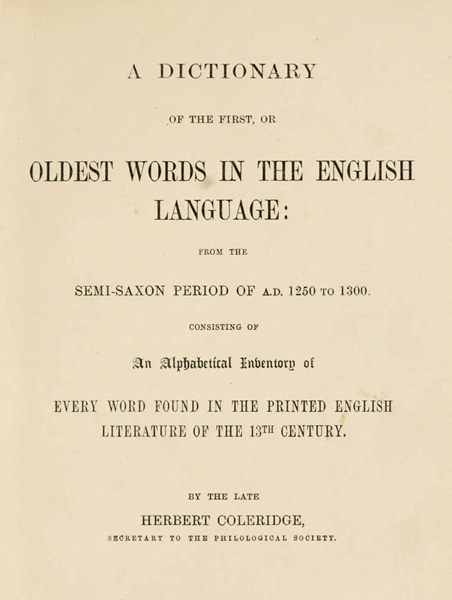
A DICTIONARY OF THE FIRST, OR
OLDEST WORDS IN THE ENGLISH LANGUAGE
A DICTIONARY
OF THE FIRST, OR
OLDEST WORDS IN THE ENGLISH
LANGUAGE:
FROM THE
SEMI-SAXON PERIOD OF A.D. 1250 TO 1300.
CONSISTING OF
An Alphabetical Inventory of
EVERY WORD FOUND IN THE PRINTED ENGLISH
LITERATURE OF THE 13TH CENTURY.
BY THE LATE
HERBERT COLERIDGE,
SECRETARY TO THE PHILOLOGICAL SOCIETY.
LONDON:
JOHN CAMDEN HOTTEN, PICCADILLY.
M DCCC LXII.
PREFACE.
The present publication may be considered as the foundation-stone of theHistorical and Literary portion of the Philological Society’s proposedEnglish Dictionary. Its appearance in a separate form has beennecessitated by the nature of the scheme, on which that work is beingconstructed. Without entering into details, which will be found in theSociety’s published Prospectus,[1] it will be sufficient for the presentpurpose to mention, that the raw material of the Dictionary, the words andauthorities, are being brought together by a number of independentcollectors, for whom it is consequently necessary to provide some commonstandard of comparison, whereby each may ascertain what he is to extract,and what to reject, from the author, or work, he has undertaken. Thisstandard for works of earlier date than 1526 is furnished by the followingpages, which contain an alphabetical inventory of every word found in theprinted English literature of the 13th century. As, however, a mere indexverborum would but inadequately fulfil its object, a certain amount ofexplanatory and etymological matter has been added, which it is hoped mayrender the work more generally interesting and useful than could otherwisehave been the case. It is only proper to add that English literature, asdistinguished from Semi-Saxon, is assumed to commence about the middle ofthe 13th century.
[1] London, Trübner and Co., Paternoster Row, price 6d.
All words are arranged under their modern forms, where such exist, but theolder forms, except where utterly unimportant, are always noticed. Themore remarkable of these older forms are also entered in the Glossary intheir alphabetical order, with cross references to that under which theword is discussed. Thus under ‘Hymn’ and ‘Isle’ will be found the forms‘ympne’ and ‘ydle;’ but ‘ympne’ and ‘ydle’ appear also in their properplaces in the[Pg iv] Glossary. Obsolete words are of course entered as they arespelt in the passage whence they are taken, a rule which applies as muchto different forms of the same word, as to different words. As to theetymological matter, nothing further as a general rule has been attemptedthan to indicate the nearest cognate, or cognates, of the particular word;but it has not been thought necessary, or desirable, to load the Glossarywith illustrations of this nature in very simple cases. I have to thankHensleigh Wedgwood, Esq., for many kind and valuable suggestions in thispart of my work.
My best thanks are also due to the Rev. J. Eas