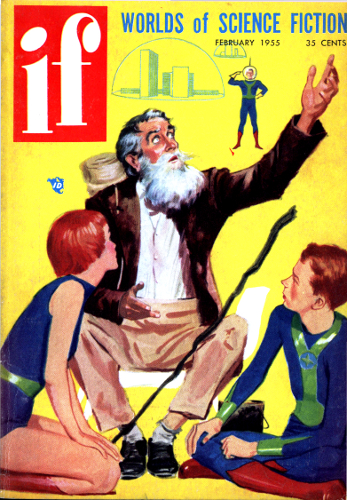
OUR TOWN
BY JEROME BIXBY
The jets got all the young ones in Smoky
Creek. Only the old folks were left—with
their memories. And the jets—friendly
or hostile—would never get them....
[Transcriber's Note: This etext was produced from
Worlds of If Science Fiction, February 1955.
Extensive research did not uncover any evidence that
the U.S. copyright on this publication was renewed.]
A jet bomber and four fighters had appeared low over Bald Ridge, out ofthe east. They'd curved up as one to clear Lawson's Hill, their stubbywings almost brushing the treetops, their hiss and thunder rollingback and forth between the valley walls like a giant's derision;they'd dipped into the valley proper, obviously informed that SmokyCreek, Tennessee (population 123) had no anti-aircraft installations,and circled the town at about five hundred feet. They circled andlooked down—broad slavic faces with curious expressions, seen throughplexiglass, as if thinking: So this is an American small town.
Then they took altitude and got to work. The first bomb was aimedat the big concrete railway bridge spanning the upper end of thevalley; that was the main objective of the attack. The bomb explodedfour hundred yards north of the bridge, at about six hundred feetaltitude—the ideal point from which to flatten Smoky Creek. Lowaltitude bombing can be tricky, of course, especially in mountaincountry. A-bombs were cheap though, turned out by the carload; not like20 years before, when they were first developed. So it was likely thebombardier tripped a bomb over the town just for the hell of it.
The next bomb got the bridge. The next tore up a quarter mile oftrack. The next tore up a quarter mile of road. That was the mission.The bomber circled, while the fighters strafed Smoky Creek for goodmeasure; and then they roared away past Lawson's Hill, over Bald Ridge,into the east toward their invasion-coast base.
Everybody died. The bombs were midget A's, designed for tactical use;so Smoky Creek wasn't reduced to dust—just to sticks. There wasn'tmuch heat from the bomb and there was hardly any residual radiation.But everybody in town died. Concussion. Smoky Creek had been comprisedof one main street and three cross streets, and that's not mucharea—the wave had thumped down from right above, like a giant fist.
Everybody died, except twenty-one old men and women who had been offin the woods at the far end of the valley, on their annual Grandfolk'sPicnic. They didn't die, except inside.
Three months later, an enemy jet came out of the sky and over thevalley. A scoop arrangement under its belly was sniffing Tennesseeand Alabama air for radioactive particles. It sniffed low over thetown, and then again—a ruined town might hide an underground lab andconverter—and then it barrel-rolled and crashed. Nine rifle bulletshad hit the motor; straight back through the jet intake, into theblades.

A year after that another jet came low over the town, and itcrashed too. Only three bullets this time; but a jet motor's like aturbine—you get a blade or two, and it goes crazy.
Two years after that, Ben Bates (no longer Mayor Ben, because a mayorhas to have a town; but still the man in charge) knocked off playinghorseshoes in what had been the Town Hall. Now the building served as arecrea